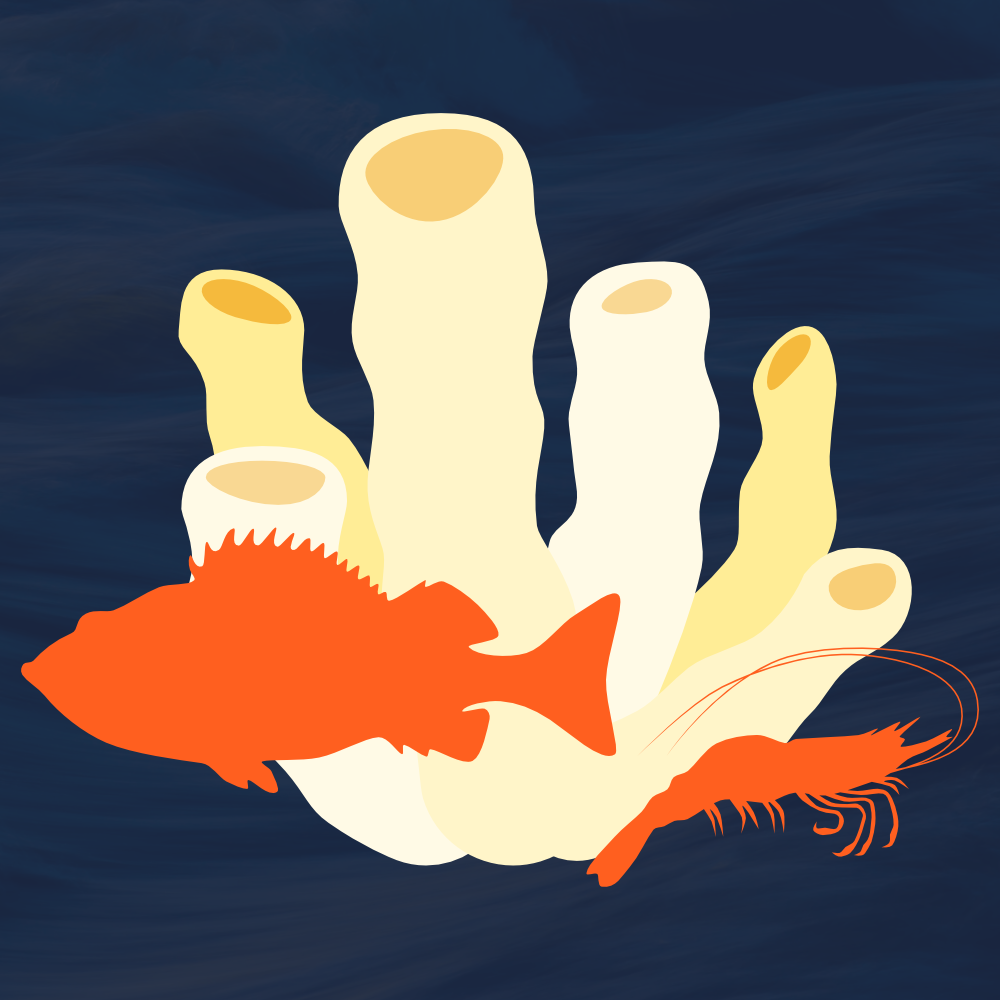
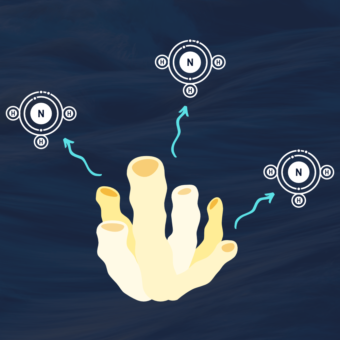
Above: Finger Goblet Sponge, Hecate Strait
(Photo: Dr Manfred Krautter)
British Columbia's living fossils
Until 1989, scientists thought that reef-forming glass sponges went extinct millions of years ago, during the age of the dinosaurs. Everything we knew about them came from fossils. Then four large reefs were discovered in Hecate Strait off the coast of British Columbia, Canada.
These 9000-year-old glass sponge reefs, some living 250 metres deep in Hecate Strait, form complexes of up to 300 km2, covering a total area of over 700 km2. Scientists recently discovered smaller sponge reefs off B.C.'s Sunshine Coast and in the Strait of Georgia, including one located off Galiano Island.
State of the Reefs
The three-dimensional structure of sponge reefs provides complex habitat on the otherwise flat sea bed. They provide shelter for many species of fish and other animals, creating areas of rich biological diversity and contributing to the sustainability of local fish species, including redfish, rockfish, lingcod, and warbonnet. Other invertebrates like crabs, shrimp and sea cucumbers have been observed sheltering among sponges and the reefs are proving to be vital habitat for BC's juvenile rockfish.
Bottom trawling, cable laying, gravel extraction, and ocean dumping are the most serious threats to sponges and other benthic organisms. These animals are vulnerable to physical damage because they grow extremely slowly and are fragile and immobile.
What is a sponge anyway?
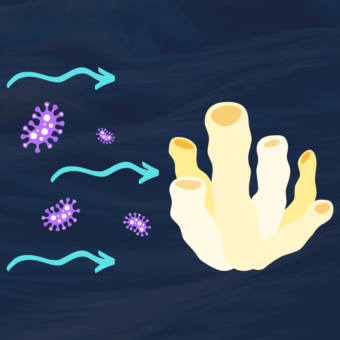
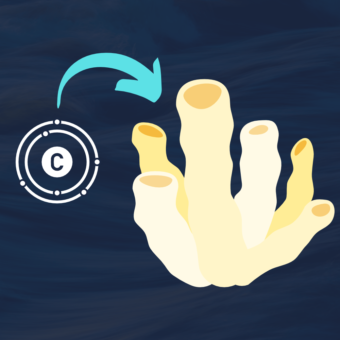
Sponges are animals that filter water through their porous body surface to extract food particles and dissolved substances. They are not mobile but stay their whole adult lives in one place, much like a plant. There are more than 7,000 described species of sponges alive today in both fresh and marine waters and many more that remain to be described and named by scientists. Different groups of sponges make their skeletons out of different materials. These materials may include silica, carbonate and protein fibres. Glass sponges make their skeletons out of silica (glass).
BC’s reef building sponges
The glass sponge reefs consist of seven hexactinellid species, three of which are the main frame builders. All three hexactinosan species attach themselves to hard surfaces on the sea floor such as rocks, boulders, or sponge skeletons. These three siliceous reef builders of the Order Hexactinosida are:
Heterochone calyx (Finger Goblet Sponge)
Heterochone calyx is funnel-shaped and grows up to 1.5m in height and 70cm in diameter. It has open-ended finger-like protrusions about 20 cm long and 5cm in diameter. The body wall can up be to 1cm thick. H.calyx is white to bright yellow in colour.
Aphrocallistes vastus (Cloud Sponge)
The funnel- or cup-shaped Aphrocallistes vastus has hollow mitten-like extensions. It is generally smaller than H.calyx, yet can still reach more than 2m in height with a body wall up to 5mm thick. A.vastus is a darker yellow hue and forms smaller clusters than those of F.occa or H.calyx.
Farrea occa
Farrea occa is a two-pronged branching round tube with open lateral branches. Its walls are less than 2mm thick and it is the most brittle of the glass sponges. They can reach more than 15m in diameter. Due to this large size the F.occa is of the most important sediment bafflers in the reef, which means that they slow down bottom currents so that sediment is transported across the reef and deposited. This baffled sediment is organic rich clay, high in silica.
Non-reef building sponges
The other four species that occur in the glass sponge reefs, of the Order Lyssacinosa, are non-reef builders:
Rabdocalyptus dawsoni, Acanthascus platei, Acanthascus cactus and Staurocalyptus dowlingi. The non-reef building sponges grow up to 50 cm in height as boot-shaped tubes. They are naturally white, however, trapped sediments and microorganisms cause them to have a grey-brown colour. Of the four species, Rabdocalyptus dawsoni and Staurocalyptus dowlingi are the most abundant. They are found both within reefs and outside of them and often settle in soft sediment, and sometimes hard substrate.
Sponge Facts
Like nothing else on Earth
As far as we know, glass sponge reefs do not exist anywhere else on the planet.
Sheltering diversity
More animals and more kinds of animals live on and around the sponge reefs compared to surrounding areas. The reefs provide complex, three-dimensional habitat on the otherwise flat ocean floor and are the basis of highly diverse communities where animals can find shelter from predators.
Rockfish nurseries
There are 10 times more young rockfish living in reefs than in surrounding areas. BC’s rockfish stocks are dangerously low in number and there is a national strategy to protect rockfish and their habitat.
Rockfish in glass sponge reef
(Photo: Dr Manfred Krautter)
Once gone…gone forever?
Reef-building sponges grow in ice scoured furrows on the bedrock of the seafloor. They may not be able to re-colonize on dead glass sponge fragments. Little is known about sponge growth rates and reproduction, but current information suggests that they are slow-growing, long-lived species which are easily damaged.
How to save a dinosaur
Because sponge reefs recover slowly, protection must be established quickly to prevent further damage. The most effective form of protection is to make these areas marine protected areas (MPAs).
Protecting the Sponge Reefs
Although these are the only known glass sponge reefs in the world, they have no permanent protection from damage by human activity. Fifty percent of the Hecate reefs have already been destroyed by fishing trawlers and research indicates that those sections of the reefs may never regenerate.
Since 2002, the federal government has closed the four Hecate Strait reefs to trawling. In the spring of 2006, the trawl closures were altered and expanded after surveys with newer technology showed that the reefs were not fully encompassed by the first closures. These closures must be renewed yearly and do not provide permanent, legislated protection.
One way to effectively protect the glass sponge reefs is with marine protected areas (MPAs). The reefs are ideal candidates for MPA because they live in stationary groupings with distinct boundaries containing high biodiversity.
CPAWS is working towards securing commitment by DFO (Fisheries and Oceans Canada) for the establishment of MPA status for the Hecate Strait sponge reefs. DFO scientists have supported the need for protection. They released a report recommending the sponge reefs receive MPA designation under the Oceans Act. In addition, the sponge reefs will be eligible for UNESCO World Heritage Site Status once they receive full permanent protection by Canada.